TFT Enchanted Wilds Enchanted Wilds Double Up Guide
How to win TFT Double Up with a partner in Set 18.
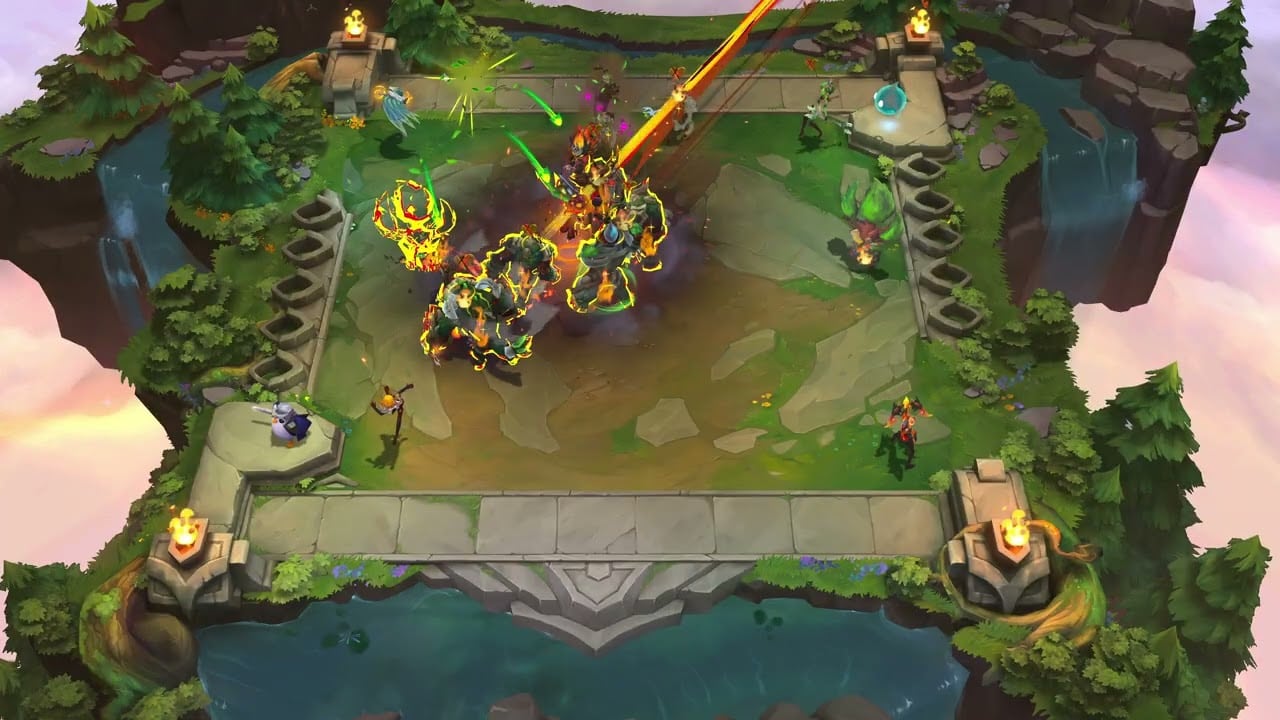
Double Up is TFT with a teammate. Four teams of two share health, send units through the Teamwork Cannon, and send reinforcements after winning fights. One player going down drags the partner with them. One clean reinforcement can flip a losing round. This page covers the Set 18 version of that loop, including the changes from the Space Gods overlap period.
Use this page if you queue with a partner. Use the ranked climb guide if you queue solo.
How Double Up works in Enchanted Wilds
Lobby: four teams of two players, eight individual boards.
Health: shared between partners. When the team pool hits zero, both players are eliminated.
Teamwork Cannon: a bench slot that sends champions or trades equal-value items with the partner. No unit-send cooldown once charged; item trades are always one-for-one at equal value.
Gift Armory: free choices that arrive on your bench addressed to your partner. Pick what they need, not what you want to throw away.
Reinforcement: after you win your fight, surviving units travel to your partner’s board after a short delay. They arrive with whatever health they had, so a clean win sends more useful help than a scrape.
Building two boards that work together
The strongest Double Up pair is not two copies of the best ladder comp. Shared champion pools make that impossible fast. If both players need the same four-cost carry and the same components, you are contesting each other before the other six players matter.
Split your needs from Stage 1:
- Different primary carries: one AD item holder and one AP item holder reduces component conflicts.
- Different roll timings: avoid both partners rerolling at the same level unless the shops naturally support it.
- Complementary fight speeds: one board can be the fast clearer while the other builds a durable frontline that survives long enough for reinforcement.
- Flexible support units: hold useful pairs only when they improve a real line.
In Enchanted Wilds, both players see the same Wisp shop. Coordinate who buys Combat versus who buys Gold or Risky orbs. If one partner is on a reroll line and the other is Fast 8, the Fast 8 player should buy the expensive Risky orbs while the reroll player hoards gold.
Using the Teamwork Cannon
The right send is often the boring one:
- Send the partner’s final copy for a two-star carry before spending bench space on a speculative three-star piece.
- Trade a dead component for the exact equal-value component that completes a real item.
- Move a utility unit when it activates a breakpoint immediately.
- Keep a sent unit off your board plan. Every temporary hold costs bench space and shop flexibility.
Check the cannon after every PvP round: charge, target, reason. Say whether it is ready, what you are looking for, and why the send matters. “Cannon ready; hold one copy of Sett; it makes my two-star” is useful. “Send me stuff” is how eight gold of bench space disappears.
Do not send a unit just because the cannon is charged. A flexible late-game send can be more valuable than a low-impact early copy.
Managing shared health
Shared health does not mean shared gold. You still control separate economies, which creates the mode’s nastiest trap: both players protecting interest while both boards lose.
Use a simple stabilization rule:
- One board weak: the weak player spends enough to stop taking heavy losses; the strong player protects economy.
- Both boards weak: both spend. Saving 20 extra gold is useless if the shared pool disappears first.
- One board one upgrade away: funnel the relevant unit or item there, then let that board clear quickly and reinforce.
- Low shared health: value immediate board strength over distant cap.
You do not need identical level timings. One partner can reroll while the other pushes levels, as long as both understand who needs units, who needs time, and who is supposed to arrive as reinforcement.
Reinforcement timing
Reinforcement rewards fast, clean wins. After you beat your opponent, surviving units travel to your partner’s fight after a short delay. They arrive with whatever health they had, so a one-unit scrape is not the same as a dominant clear.
Build around three questions:
- Who is expected to win first? Position that board for damage and target access.
- Can the other board survive long enough? Add frontline, crowd control, or safer carry positioning when the answer is no.
- What arrives alive? A durable frontline crossing over can matter more than a glass-cannon unit that dies before the portal opens.
Scout both opposing boards. Your own matchup might be easy while your partner is about to face a burst-heavy board. Swapping one unit or moving a carry can buy the seconds needed for reinforcement.
The biggest difference between decent Double Up pairs and great ones: great pairs do not ask only “Can I win?” They ask “Can I win fast enough to matter?”
Communication that saves HP
Good Double Up comms are short and actionable. Call these:
- Board strength: “I am weak this round” or “I should clear fast.”
- Key pairs: “Hold one copy of X.”
- Component needs: “I can finish tank item with Belt.”
- Roll timing: “Rolling at 3-2; ping my units.”
- Opponent threat: “Their carry is right side; protect yours.”
- Reinforcement plan: “Stall; I should portal.”
Ping the unit or item after the call. During a 30-second planning phase, “Need this” plus a ping beats a speech.
Silence also has a cost. If your partner does not know you are rolling, they sell the copy you needed. If they do not know your board will lose fast, they position for damage instead of survival. Two five-second updates can save 15 shared HP.
Common mistakes to avoid
Both players force the same comp: agree on separate carries and backup lines before Stage 3 unless the shops give you an absurd reason not to.
Gifts are chosen without asking: the Gift Armory is free, but a useless reward still wastes team power. Ask what completes an item or fixes the board.
One player hoards all the help: sending every premium unit to one capped board leaves the other unable to survive until reinforcements. Fix the losing board enough to buy time.
Both players greed at low health: there is no old one HP safety shield. When the shared pool is in lethal range, roll and level for now.
Nobody scouts the partner’s matchup: your board is only half the round. Check what your partner faces, then decide whether you need to clear faster or help them stall.
Enchanted Wilds Double Up specifics
Set 18 Wisps affect Double Up in ways standard ladder does not. Because both players share a shop, a Wisp that one partner skips is still visible to the other. Use this to coordinate: if the AP partner never buys Combat Wisps, the AD partner can grab them without waste.
Blossom 5 puts a Wisp in every shop. In Double Up, that means both players get a Wisp every round. Coordinate which partner benefits more from Blossom 5 shops before both of you start buying orbs.
Riftbeast Alpha Mark still targets one unit per battle. Partners should agree on whether the Mark goes on the board that wins faster or the board that needs the extra damage to close.
Eclipse execute from three Solar plus three Lunar still triggers in Double Up. If both partners can build toward it, the execute can clean up fights that reinforcements alone would not flip.
For more on Enchanted Wilds systems, see the getting started guide, Wisps guide, and the comp tier list.
Frequently Asked Questions
Quick answers for Enchanted Wilds players.
Can you queue Double Up solo?
Yes. You can enter without a premade partner, but the mode gets much easier when both players communicate about items, units, economy, and reinforcement timing.
Does Double Up use shared health?
Yes. Both partners draw from one team health pool. When it hits zero, both players are eliminated.
How does the Teamwork Cannon work?
The cannon sends champions after a cooldown and trades eligible basic or completed core items at equal value without that unit-send cooldown. It takes a dedicated bench slot.
What should two partners play in Double Up?
Play lines with different primary carries and limited unit overlap. One fast-clearing board plus one durable board is often easier to coordinate than two greedy boards competing for the same four-costs.
Does Double Up have ranked?
Yes. Double Up supports ranked play with its own rules. Riot allows broad rank mixing, while full eight-player custom parties do not change LP or MMR.